
Ocean sailing
After taking a few days to cover Strait of Juan de Fuca, we rounded the Cape Flattery and turned south. We entered the Pacific Ocean and started our ocean sailing.

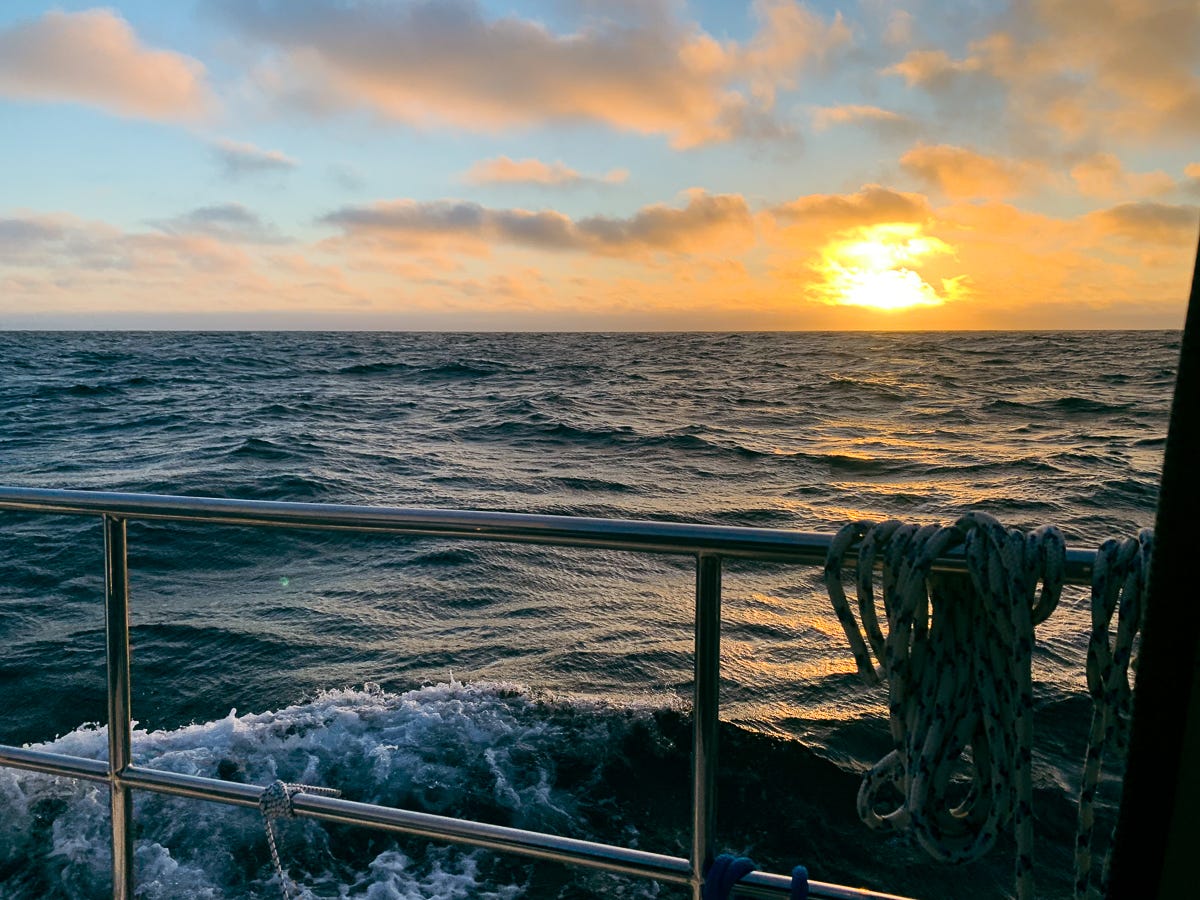
The first few days after leaving Port Townsend did not feel very different, yet. We took it slowly, especially since the Strait of Juan de Fuca has a reputation for kicking up some nasty waves when the wind picks up and the current is going out. We did our best to avoid those.
Right after leaving Port Townsend, we got a preview, or rather no-view, of what we would encounter during most of the trip - a dense fog. It was so thick that we could not see other Coho Ho Ho boats that were sailing half a mile away from us. Thank goodness for the radar and AIS. The situation improved in the afternoon, and soon we reached Port Angeles. The marina in Port Angeles - Boat Haven - is clearly different from what we were used to in Puget Sound so far. Lots of fishing boats, some older ones, and older docks. The marina is also located away from downtown, and there is not much around it. We learned later that a better choice, and much cheaper, would be the city dock located next to the ferry terminal. We spent a day in Port Angeles, waiting out the worst of the winds, and departed on the following morning towards Neah Bay. This year, Neah Bay, being the Native American land, is still closed for visitors due to COVID-19 restrictions. But the bay is very large and has plenty of room for a lot of boats. We picked up a spot and soon were joined by several others going in the same direction. One of them - s/v Maya - we would be crossing paths with many times on this leg.
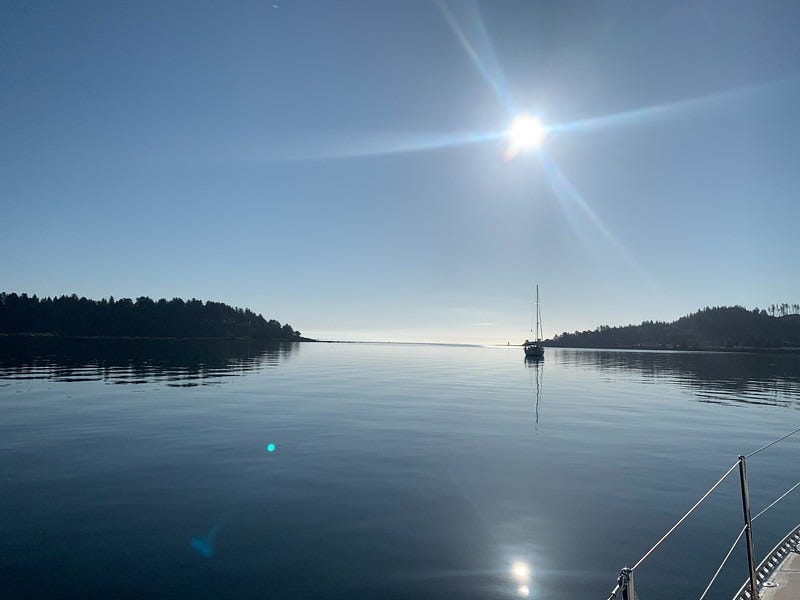
The next day we woke up to a beautiful, sunny morning. We took our time, as our route calculations called for a late departure. Shortly after noon, we picked up the anchor and headed out. An hour later, we started our Big Left Turn - going around the Cape Flattery. This is the most northwest point of the continental United States (not counting Alaska) and a place where the Strait of Juan de Fuca ends and the Pacific Ocean begins.
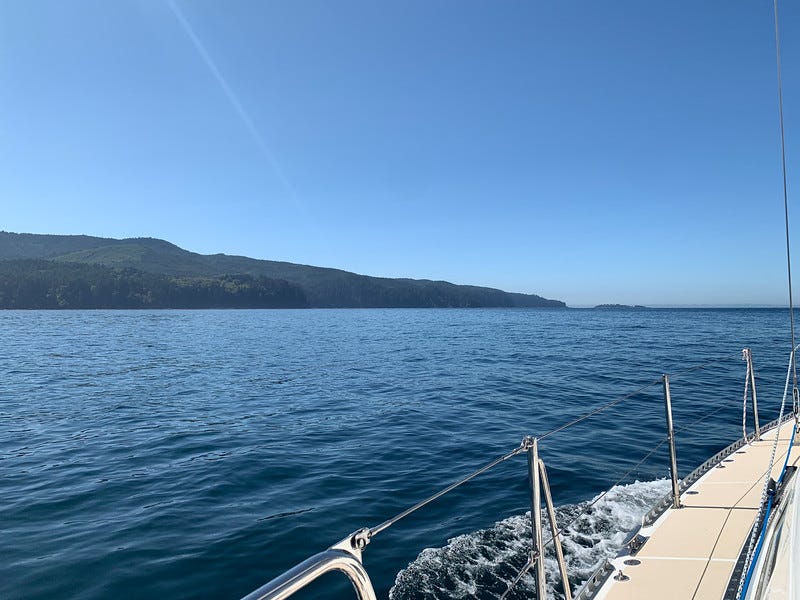
We noticed that the ocean swell has increased and the boat's motion has changed. Soon after, we could roll out the sails and turn off the engine. The wind picked up from the back, 10 - 15 knots, and we turned south.
We were sailing in the ocean!
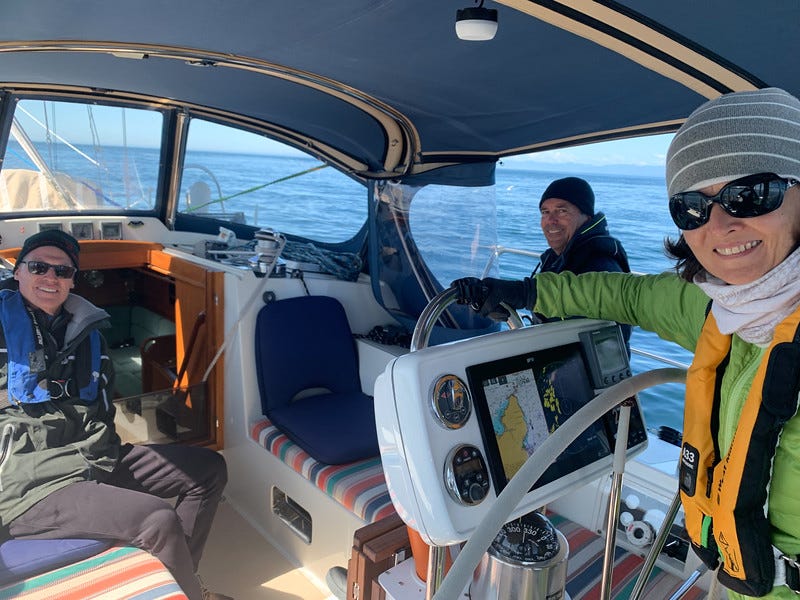
The first several hours were exciting and encouraging, but also clearly more challenging than anything else we had to deal with so far. We were not in Kansas anymore - or specifically not in protected inland waters of the Pacific Northwest. The sea state was definitely more than we were expecting - we had swell from one direction and wind waves, building up, from another. The boat moved in a corkscrew fashion. It never felt dangerous, but not necessarily comfortable or familiar.
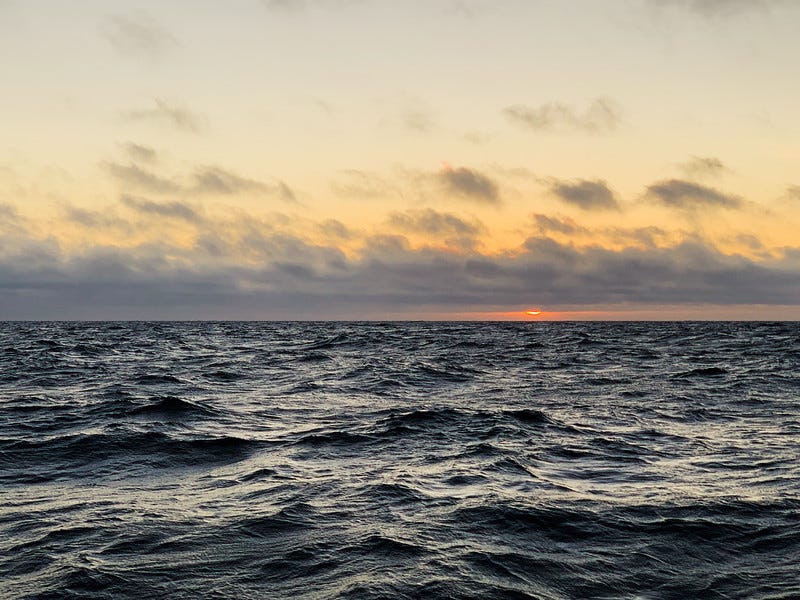
It got somewhat worse when the day ended. Night tends to amplify the experience and the emotions. Especially when you are off-watch, lying down in the bunk, and not seeing what is happening. The fear of the unknown builds up, and you start thinking about all the "what ifs". I lay down and listened. The boat moved in a new way. There were new sounds that I had never heard before. I realized that we are alone on a vast ocean in a small boat, miles and miles away from anyone. And that we are moving further out. I felt that the trip up the coast, a year ago, prepared me better for this, but this time, the difference was that I was the skipper and everyone depended on my decisions. That first night, I could not sleep much, with a lot of thoughts swirling in my head. That did not help much, as the next day I was really tired. Olena got seasick that first night, and she had to recover. I was very grateful for our crew - Steve and Drew - without them, it would have been very hard.
We also realized that we need to learn some new techniques. For example, sailing with the jib or genoa poled out. What that means is that you attach the clew of your front sail to a pole extended from the mast, perpendicular to the boat, and stabilized by lines fore and aft. It keeps the sail extended out when you are sailing on deep downwind angles, as we tend to do when going down the coast. Without that, the sail often collapses and fills back in with a big bang, which is not good for the sail nor for the rigging. The alternative for us was to sail more upwind and gybe more often or use the mainsail only. For a while, we did the latter to make things easier for us.
Throughout the night, the winds eased, and we switched to motoring. But the next day it got stronger again, and the waves got even bigger. It was more of the washing-machine effect and had a compounding effect on us. We gybed at night, which was another first-time experience, and turned towards Newport. The sun rose, the fog cleared, and we had an easy entrance over the river bar and into the Newport marina. We docked at the guest dock and were joined soon by s/v Maya and s/v Meraki, and later, other cruising boats.
We covered 263 nautial miles in 2 days and 2 nights
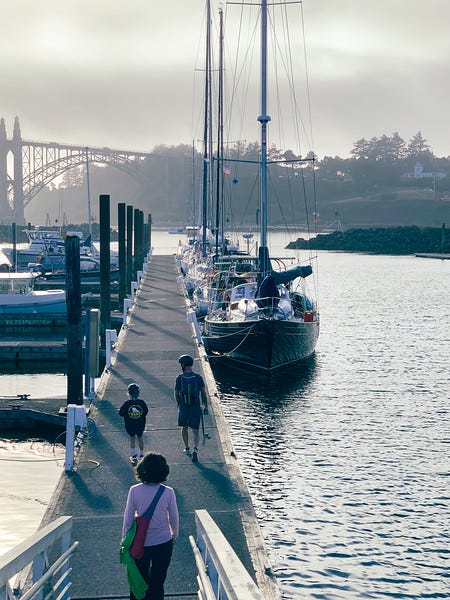
The celebratory beers at Rogue Brewery tasted really well and helped ease the anxiety of the passage.
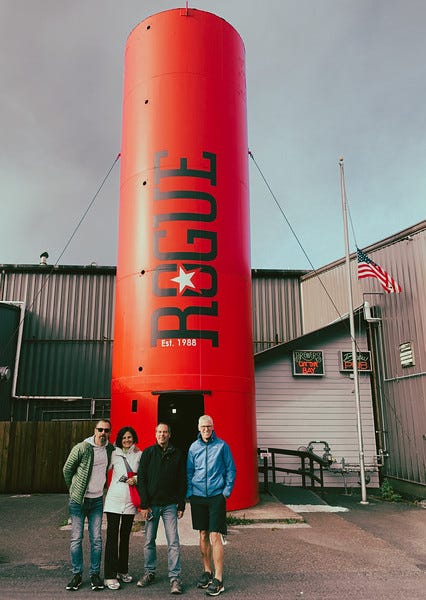
That passage was very humbling for me. You quickly learn that there is a whole new learning curve when sailing in the ocean. Years of experience from the Salish Sea and the confidence coming with it are essential, but are not enough. The sailing is harder, scarier, more demanding in the ocean. We did it, but it was a good reality check. As many people say, it is a lot about what's in your head, and I think it is true. Being mentally and emotionally prepared is important. At the same time, there is really no way to prepare other than by doing it. After those first days, things were not always easier, but we became more used to everything and tolerated it better. But this first passage will always be the first big one.
